
LINGOT is a musical instrument tuner. It’s accurate, easy to use, and highly configurable. Originally conceived to tune electric guitars, it can now be used to tune other instruments.
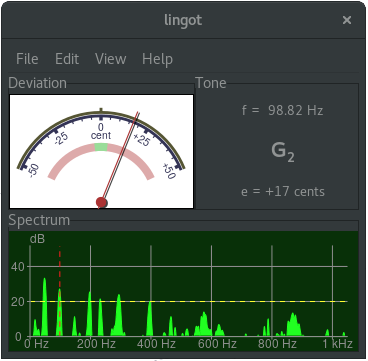
It looks like an analogue tuner, with a gauge indicating the relative shift to a certain note, determined automatically as the closest note to the estimated frequency.
Features
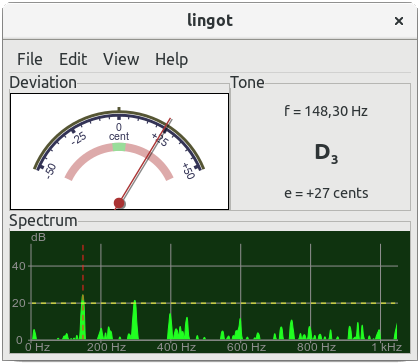
This application has the following features:
- It’s free software. LINGOT is distributed under the GPL license.
- It’s really quick and accurate, perfect for real-time microtonal tuning.
- Easy to use. Just plug in your instrument and run it.
- LINGOT is a universal tuner. It can tune many musical instruments, you only need to provide the temperaments. For that purpose, it supports the Scala project .scl format.
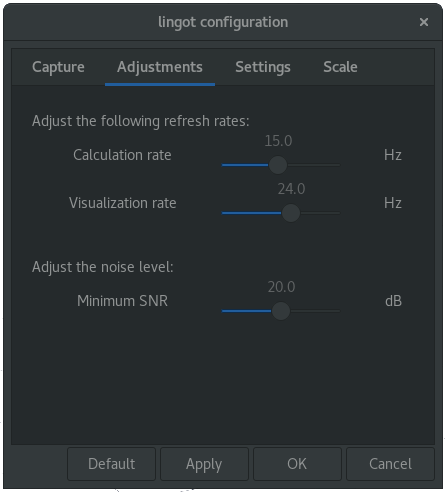
- Highly configurable via GUI. It’s possible to change any parameter while the program is running, without editing any file.
News
You can follow the activity of this project visiting our news page at Savannah. New releases and features are published there. You can also subscribe to the news feed .
Screenshots

Downloading and Installing LINGOT
Source code
Follow this link to download the latest source code of lingot.
You can also get the latest release of the sources from our Git repository. The command for getting the files is the following:
git clone https://git.savannah.nongnu.org/git/lingot.git
Binary distributions
There are some precompiled packages available. Some linux-based distributions have adopted LINGOT to be part of their software repositories.
The Debian distribution and other derived distros includes a precompiled version of LINGOT. Thanks to Niv Sardi Altivanik.
System Requirements
Your system must satisfy the following requirements to run LINGOT properly:
- A modest computer running GNU/Linux.
- A sound card with line-in or microphone input.
- Jack, ALSA, OSS or PulseAudio support.
- GTK+ library, version 3.10 or above.
Further info
You can get more information about LINGOT visiting our project page at Savannah. We encourage you to subscribe to the mailing lists we have created — you can expose there any question, suggestion or anything else. We appreciate any feedback and/or collaboration you might want to make.
Authors
LINGOT was originally developed by: